Engineering, Invention and Technology How Engineers Do Their Technical Magic
By: John Shepler
Imagine a world without engineering and you'll have to give
up much more than personal computers, jet planes and television.
You can also forget about roads or riding anything more high
tech than the horse. There would be no bridges, no appliances,
no electricity, gas heat or even running water in your house.
You would have shelter, say a log cabin, mud hut or a cave, but
certainly not a high rise office building. Life would be...well...back
to nature. If you want something beyond what nature cares to
provide, then you need an engineer or maybe lots of them.
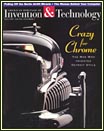
I've been re-reading an issue of
one of my favorite magazines, American Heritage of Invention
& Technology, and pondering a bit on the subject of what
engineering really is. As someone who got enthralled with science
and radio projects as a kid and went on to pursue a career in
engineering for, oh my gosh, almost 30 years now, I've been so
close to the subject that I never gave it much thought. But every
once in awhile, someone will say right out of the blue "so
what is it you engineers really do?"
If you peek into a room where engineers are working, you might
never figure it out. You'll see them sitting quietly at desks,
looking at papers, making notes, opening various books from time
to time and filing papers in binders. In years past, you might
have seen more of them at drawing boards with mechanical pencils
and slide rules. Today, they do what most everybody in an office
does, stare at computer screens and type on a keyboard or manipulate
a mouse. No, you won't learn much peeking in on engineers anymore
than you'll figure out what writers are up to by watching them
from afar. To learn the secrets you have to get inside their
heads. The real magic is happening in the mind. You'll also have
to speed up time, because the results of engineering are often
measured in months and years.
Perhaps the best way to understand engineering is through
the stories of what great engineers have accomplished as their
life's work. Thomas Edison was such an engineer. We all know
he invented the light bulb after painstaking test after test
after test to find a material that would glow but not burn up.
Had Edison confined his work to testing thousands of formulations
and dutifully recording their characteristics, we might call
him a scientist rather than an engineer. Scientists give us new
knowledge. They probe, they measure, they investigate, they theorize.
They give us new formulas and predictions. Engineers also engage
in these activities to a degree, but engineers have a different
end in mind. Engineers are trying to make something.
Edison made the electric light. But he also built power houses,
distribution wiring and everything that was needed to make the
bulbs light up with the flick of a switch. Today we take such
infrastructure for granted, but there were no power plants, electric
lines, or even light sockets when the incandescent bulb first
lit up in Edison's lab. All of that needed to be figured out,
or engineered.
Invention & Technology magazine has a story about an engineer
you may not know, named Howard Aiken. As a teenager he got a
job installing telephones to support his mother and grandparents.
Someone in the school system recognized how talented he was with
mathematics, and helped him get a night job with the gas and
electric company so he could finish his education. He studies
eventually led him to Harvard University, where he found himself
mired in extremely time consuming calculations of differential
equations in support of his Ph.D. research thesis.
This is where the scientist turned engineer as Aiken realized
he could devise a machine to automate the endless repetition
of calculation. He sat down and listed the steps a machine would
go through in doing the calculations, figured out what information
would have to be input to the machine, the tables that would
need to be stored, and what the results would be. He wrote what
we call a design specification. Then he went out for help.
IBM got interested in the project and assigned a group of
their engineers to translate Howard Aikens specifications into
a design using components that IBM already had, including electromagnetic
relays, rotary switches, counters, paper tape readers and electric
typewriters. There were 760,000 parts in all. When it was finished,
the Mark I stood 51 feet long, weighed 5 tons and in 1944 was
the world's first general purpose programmable computer. During
the later years of World War II, the Mark I ran almost continuously
24 hours a day working problems for the defense department, including
studies on protecting ships from magnetic mines and the development
of the atomic bomb.
The Mark I design was copied for the Mark II and then expanded
for the next machine, the Mark III, which was built with a magnetic
drum memory and vacuum tubes for faster operation. That's another
characteristic of engineering. As engineers learn, they improve
on their designs and contribute improvements to the designs of
others. You can see this in the rapid evolution of personal computers
from being able to do just word processing, spreadsheets and
simple games a decade ago, to the worldwide Internet communication
we have at our fingertips today. You can bet that there are thousands
of engineers who, right now, are devising ways to make computers
offer services we can't imagine today...but won't be able to
do without tomorrow.
Magazines and Books of Interest:
American Heritage of Invention & TechnologyMagazine
puts the amazing history of American inventiveness in your hands.
The magazine's clear writing and beautiful graphics help to explain
how the extraordinary ideas, machines, and inventions of America's
great inventors have changed the entire world over the past two
centuries. Read all about Edison, the Wright Brothers, Robert
Fulton, and many other notable inventors. This is one of my personal
favorites and make a great gift, especially for aspiring engineers
and inventors.
Existential Pleasures of Engineering by Samuel C. Florman.
Exploring how engineers think and feel about their profession,
this book discusses engineering as neither cold nor passionless,
but instead a pursuit rich in both spiritual and sensual rewards.
Florman emerges with a practical & creative philosophy of
engineering that proves his pride in his craft.
High Tech Start Up The Complete Handbook for Creating Successful
New High Tech Companies by John L. Nesheim. "High Tech
Start Up" presents a classic, step-by-step strategy for
making a solid plan and securing multiround financing. Author
Nesheim--a premier start-up veteran, having single-handedly structured
over $300 million in new venture deals--provides more than 23
case studies that reveal how readers can modify their strategies
to fit their particular objectives.
The Introspective Engineer by Samuel C. Florman. An
exciting look at how engineering and engineers can shape the
future of our society--from the author of the classic The Existential
Pleasures of Engineering. In this elegantly reasoned and passionately
argued book, Samuel Florman suggests that at this moment in history,
a few good technological fixes are just what the world needs.
Also visit these related
sites:
National Engineers Week
- Celebrated every February since 1951, from the National Society of Professional Engineers.
Milwaukee School of Engineering - My Alma Mater and one of the finest schools in the country for engineering. Now known as Milwaukee University, as the curriculum has expanded beyond the technical focus.


 I've been re-reading an issue of
one of my favorite magazines, American Heritage of Invention
& Technology, and pondering a bit on the subject of what
engineering really is. As someone who got enthralled with science
and radio projects as a kid and went on to pursue a career in
engineering for, oh my gosh, almost 30 years now, I've been so
close to the subject that I never gave it much thought. But every
once in awhile, someone will say right out of the blue "so
what is it you engineers really do?"
I've been re-reading an issue of
one of my favorite magazines, American Heritage of Invention
& Technology, and pondering a bit on the subject of what
engineering really is. As someone who got enthralled with science
and radio projects as a kid and went on to pursue a career in
engineering for, oh my gosh, almost 30 years now, I've been so
close to the subject that I never gave it much thought. But every
once in awhile, someone will say right out of the blue "so
what is it you engineers really do?"