If nature celebrated her independence, wouldn't it be the
same way we do? With a huge celebration, a tremendous visual
display of color in the sky?
Welcome
to autumn's brilliant independence party. Now the restful green
of summer's productivity explodes into a harvest festival of
yellows, reds, oranges and chocolate browns. Little ones and
big ones, high in the treetops and all along the hedges. The
leaves of fall are going out in flashes of color. Flashes that
peak only for a few days and then flicker out as they wither
on the ground.
While our Independence Day fireworks illuminate the heavens
with much noise and sparkle, they awe us for less than an hour
in the night sky. Nature's time scale is more relaxed, and far
more filling of our visual environment. From late September until
early November, there is a month's time set aside to celebrate
the bounty of this year and prepare for the time of rest before
the cycle begins anew in the spring. This is nature's big hurrah.
"Hooray for us! We did it once again! We harnessed the energy
of the universe and converted it to fuel the engines of life.
Life in all its forms and glory has grown and prospered on the
Earth. Thanks everyone. See you again next year!"
Science, man's explanation of why nature does what it does,
misses the sheer wonderment and excitement of it all, but gives
us some insight on how this cycle waxes and wanes with such regularity.
There is a science of fall. It is the chemistry of autumn, the
physics of foliage. As we change our viewpoint from the synthesis
of life's grand celebration to the analysis of cellular interactions,
we get to peek inside the living machines and see how leaves
and trees and water and sunshine all communicate in nature's
rhythm.
Why do the leaves change color and fall off the trees each
year? Why shouldn't they just stay as they are, green and unvarying,
year after year? In some cases, they do. Just look at the evergreens.
Unless they are damaged by people or animals, or an unusually
strong wind, they keep their needles, their type of leaves. The
inner ones may die off from lack of sunlight, but there is a
constant growth of new soft needles extending the perimeter of
the tree each year.
Not so with the deciduous trees, our favorite elms and maples
and oaks. Their annual life cycle is more dramatic. The reason
has to do with the way the leaves are constructed. They are large
and flat and thin, and full of moisture. In the depths of January's
deep freeze, the watery sap surrounding the leaf cells would
surely freeze, and the ice crystals would penetrate and destroy
the cells. If the freezing action extended down the branches
and throughout the tree, there would be no living tree come spring.
So nature's way is to seal off the hydraulic connection between
branches and leaves, weakening the bond so that the leaf flutters
away in the next available breeze. It has served its purpose
well during the long days of summer. A leaf is actually a little
sugar factory. The warmth and light of summer allow the leaf
to synthesize chlorophyll, the green compound that gives leaves
their color. Chlorophyll absorbs red and blue light from the
sun which becomes energy, like the energy of a battery, to cause
chemical reactions. In this case, carbon dioxide, the stuff we
breathe out, is pulled from the air. The leaf uses it plus water
from the soil to make chlorophyll plus oxygen, the stuff we breathe
in. In this way plants and animals complement each other, so
we both get what we need in an exchange of air.
Chlorophyll does something else for the tree, though. It also
creates sugars and starches that are used as food by the tree,
so it can grow and produce seeds. This process is called photosynthesis,
the synthesizing or creating of chemicals from photo or light
energy.
There is another photo term, photoperiodism, the response
of a plant to the lengthening and shortening of daylight. Photoperiodism
is what signals the onset of fall. As days get shorter and shorter,
there is less sunlight to activate the leaves. The chemical factory
loses energy and slows to a crawl. Less sugar and starch is produced,
less chlorophyll is synthesized to replace what has degenerated.
As the chlorophyll fades, so does the green color of the leaf.
What's left are other chemicals, the yellow pigment of carotene
and the red of anthocyanins. Oh, they were there all along during
the summer. It's just that the intense green of the abundant
chlorophyll hid them until it no longer could. Now, in the fourth
quarter of the year, they burst forth to add their radiance to
the sky and ground show of autumn.
So, who's to say? Are the fall colors we enjoy so much really
nature's celebration of life's independence in a cold and barren
universe, or are they simply the product of mundane chemical
reactions acting in response to the wobbling of the planet on
its axis?
Perhaps the Native Americans touched the soul of autumn's
meaning in their myth of the hunters, who killed the Great Bear
in the sky, spilling its blood on the forests and turning some
of the leaves red. Some leaves became yellow, as the hunters
cooked the bear's meat and dripped fat on other trees in the
forest. This, too, is a story of life and the endless cycle of
nature growing, harvesting and nourishing to grow again.
Preserving
Autumn Leaves - More thoughts on how to preserve autumn leaves
and use them for decorating.
Indian
Summer - Thoughts on the magic of those warm, dry, hazy mid-autumn
days of pure beauty and temporary escape.
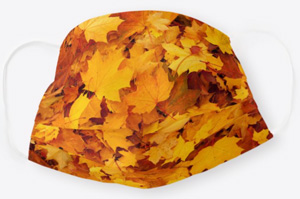
Indian Summer Golden Leaves - A carpet of golden autumn leaves signals the last warm days of Indian Summer in the fall season. Find gifts that remind you of this special time.


 Welcome
to autumn's brilliant independence party. Now the restful green
of summer's productivity explodes into a harvest festival of
yellows, reds, oranges and chocolate browns. Little ones and
big ones, high in the treetops and all along the hedges. The
leaves of fall are going out in flashes of color. Flashes that
peak only for a few days and then flicker out as they wither
on the ground.
Welcome
to autumn's brilliant independence party. Now the restful green
of summer's productivity explodes into a harvest festival of
yellows, reds, oranges and chocolate browns. Little ones and
big ones, high in the treetops and all along the hedges. The
leaves of fall are going out in flashes of color. Flashes that
peak only for a few days and then flicker out as they wither
on the ground.